PCS Move Survival Guide: What to Ship, What to Sell, and What to Pack in the Car
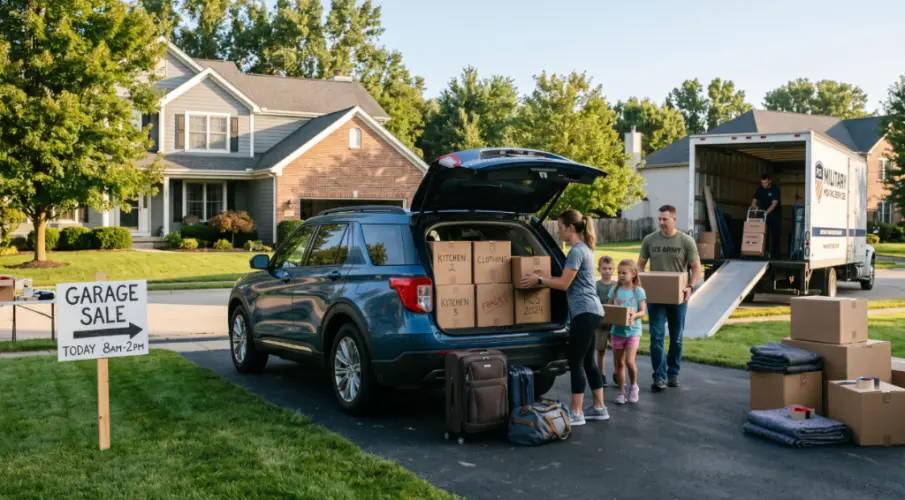
The Smiths got their orders on a Friday in March. Report date: June 1. Twelve weeks. It feels like a long time. By week three of trying to figure out what their two vehicles, three bedrooms of furniture, a kid's drum kit, and 14 years of accumulated stuff was supposed to do across 1,800 miles between Fort Bragg and Joint Base Lewis-McChord, it was already late.
The hardest part of a PCS isn't packing. It's deciding what gets to be packed in the first place. Every family I've talked to who said their move went well had the same trick: they sorted everything into three buckets early. Whatever didn't land in one of the three buckets got cut.
Here's the framework, and how a vehicle fits into it.
The PCS Timeline Most Families Wish They'd Started Earlier
Twelve weeks out feels comfortable. It isn't. The 12-week mark is when you should already be done with bucket sorting. By week 10 you should be on the TMO portal. By week 8 you should have a TMO move date confirmed. By week 6, your car mover should be booked.
The mistake families repeat: they wait for orders to be cut before they start, and orders sometimes shift report dates by two weeks in either direction. That can cost you a HHG slot, a flight at a reasonable price, and any auto transport carrier worth booking. Start the bucket sort the day you have a verbal heads-up, even if orders are not in writing yet.
Bucket 1: What HHG Should Actually Ship
The Defense Personal Property Program will move almost anything. That doesn't mean everything should go through it. Things to send via HHG with full confidence:
- All furniture you actually want to keep
- Books, clothes, kitchen, linens
- Children's bedrooms, intact
Things to never let HHG movers touch:
- Anything irreplaceable. Wedding photos, military records, kids' birth certificates, a unit coin collection. These travel in the family car or on a flight, never in a HHG crate.
- High-value items you cannot prove the value of without a receipt. If you can't replace it through DPS claims, you can't afford to have it lost.
- Anything fragile that wasn't in its original box. Movers will pack it. The carrier will haul it. Whether it survives is up to the road.
The most common claim filed against HHG is small-electronics damage. The second is broken framed art. The third is a vehicle, which brings us to bucket 3.
Bucket 2: What to Sell Before the Move
Selling before a PCS does two things: it shrinks the weight allowance pressure, and it stops you from paying to ship something you would have replaced at the destination anyway. The list almost every PCS family wishes they'd cut sooner:
- The 12-year-old grill on the patio
- Bulky workout equipment that hasn't been used in a year
- The fourth set of dishes that came from somebody's grandmother and lives in the garage
- The second TV in the spare room
- Yard tools you're going to need a different version of in your new climate
Facebook Marketplace and the base classifieds clear most of this in two weekends. What you don't sell, donate.
Bucket 3: What to Ship Separately
This is the bucket families undercook. It's anything that needs to travel but should not go in the HHG container. The list almost always includes:
- Primary vehicle
- Spouse's vehicle (if two-car household)
- Motorcycle (HHG won't ship most bikes safely)
- High-value bicycle
- Boat or trailer
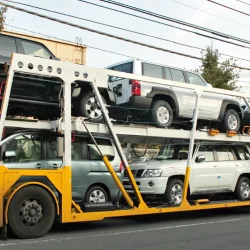
For the vehicles, the choice is drive or ship. For everything else on this list, the choice is ship or sell. Auto transport handles all of it, including motorcycles and small boats, and the carrier insurance picks up where DPS claims have gaps.
Two-Vehicle Households: Drive One, Ship One
Almost every PCS family with two cars eventually lands on the same plan: one adult drives one vehicle, the other vehicle gets shipped, and the family flies. There are three reasons this works.
First, a 1,800-mile drive in one vehicle costs roughly $400 in gas, $300 in motels, and three days off work. A 1,800-mile drive in two vehicles costs all of that twice, plus the headache of staying in convoy for three days with a kid who needs a bathroom every 90 minutes.
Second, the second car becomes the family vehicle from the moment it arrives. Shipping it means the spouse who flies in is not stuck waiting for delivery before picking the kids up from base school.
Third, and this is the part that surprises people, shipping is often cheaper than driving once you count vehicle depreciation. A 1,800-mile haul puts about 0.7 cents per mile in extra wear on a 5-year-old SUV. That's roughly $1,300 in residual value. Most PCS families have never run that math.
PCS Auto Transport: The Discount Math
Most reputable car shipping companies offer 8% off auto transport for active duty and retired military, and 10% off for disabled veterans. A few stack an additional 5% off for multi-vehicle or returning customers. On an $1,100 base quote, that's $88 to $110 saved, which is about a tank of gas and a hotel night.
Verify the discount is real before you book. The standard test: get the published civilian quote, then state your status and ask for the military rate in writing. If the new number isn't at least 5% lower, the discount was never there. Ask whether the discount is honored when the carrier delivers, or only as a marketing line on the website. There's a difference.
When you're comparing options, look at this auto transport company that specializes in military moves along with one or two others, and ask each the same question.
Coordinating Pickup with TMO and Your Report Date
The hard part of timing a PCS vehicle shipment is that TMO sets your HHG pickup window, you set your report date, and the carrier sets the pickup window for your car. Three calendars, one move.
The pattern that works: book the auto transport pickup for the week after HHG packs out, but the week before your flight. You leave the house empty, the car gets picked up from the driveway or a nearby coordinator address, and you fly. Your car arrives 5 to 10 days later at the destination, which lines up with you having a place to put it.
For a coast-to-coast PCS, plan a 7 to 10 day transit. Northeast to Florida or Texas to the Mountain West is closer to 4 to 6 days. Use the FMCSA SAFER system at safer.fmcsa.dot.gov to confirm any broker or carrier you book is in good standing. It takes 60 seconds and tells you whether their authority is active.
Settlement: How to File If a Vehicle Gets Damaged
The bill of lading is your one piece of recourse. Sign it carefully at pickup. Walk the entire vehicle with the driver, photograph every existing scratch, and make sure each one is noted on the inspection sheet. Do the same at delivery. New damage must be marked on the bill of lading at the moment of delivery, before you sign it off, or you lose the right to file.
If something is wrong, the claim window with most carriers is 24 hours. The carrier's cargo insurance, which is typically $100,000 to $250,000 in coverage, handles the cost. The Better Business Bureau is the right place to escalate any unresolved broker dispute, and the FMCSA is where to file a formal complaint if a broker fails to perform on what they agreed to.
A PCS is hard. The vehicle part doesn't have to be. Sort everything into the three buckets the day you get the verbal, ship what should be shipped, drive what should be driven, sell what should be sold. The Smiths figured this out by their fourth move. You don't have to wait that long.